
The hospitality technology landscape has transformed dramatically over the past few years. For small hotel operators, the challenge isn't finding technology solutions—it's choosing the right combination of tools that work together seamlessly without overwhelming your operations team.
After working with dozens of small hotels across the Mediterranean region, I've identified the core components every property needs to compete effectively in 2026. This guide walks you through building a tech stack that enhances guest experience, streamlines operations, and protects your revenue.
Understanding Your Tech Stack Foundation
A hospitality tech stack isn't simply a collection of disconnected software tools. Think of it as an interconnected ecosystem where each component serves a specific purpose while communicating with others. For small hotels with 20-50 rooms, this means avoiding bloated enterprise systems while ensuring critical functions integrate seamlessly.
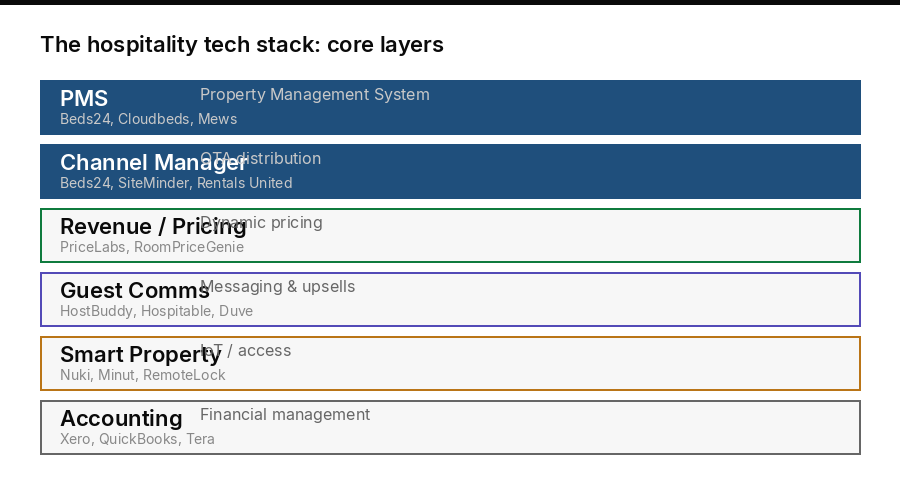
The foundation of any modern hotel tech stack consists of five essential layers:
- Core Reservation & Operations (PMS) - Your central nervous system
- Distribution & Channel Management - How guests find and book your rooms
- Revenue Management - Maximizing your income
- Guest Communication & Experience - Before, during, and after arrival
- Back-office Integration - Accounting, reporting, and data management
1. Choosing the Right Property Management System (PMS)
Your PMS is the backbone of your operation. This system manages reservations, guest profiles, room inventory, rates, and staff scheduling. Unlike five years ago, small hotels now have legitimate alternatives to expensive enterprise systems.
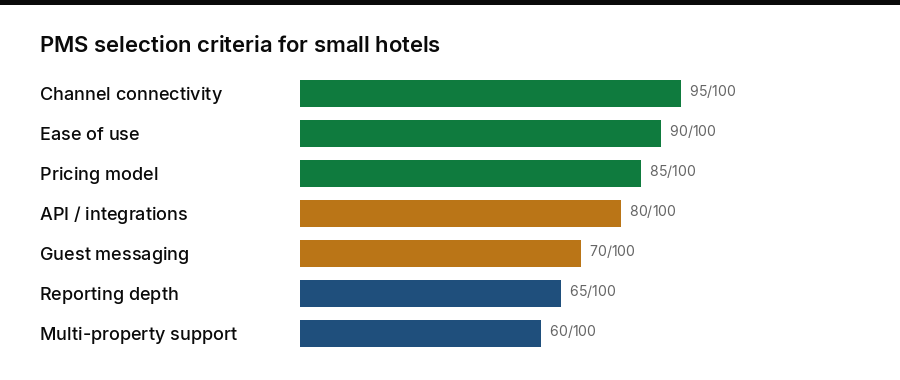
PMS Selection Criteria for Small Properties
When evaluating PMS options, prioritize these factors over feature count:
- Ease of Use - Your front desk staff will use this daily. Complex systems create errors and frustration.
- Scalability - As your property grows, the system should grow with you without requiring migration.
- Integration Ecosystem - Can it connect with channel managers, payment processors, and accounting software?
- Cloud-Based Architecture - Ensures accessibility from anywhere and automatic updates without disruption.
- Mobile Access - Guest-facing and staff-facing mobile apps are essential in 2026.
- Transparent Pricing - Avoid systems with hidden per-user or per-transaction fees.
For Mediterranean small hotels, systems like Opala, Hotelogix, and emerging regional solutions offer excellent value. The key is selecting something your team will actually use consistently rather than working around.
2. Channel Management & Distribution Strategy
Most small hotels derive bookings from multiple channels: your direct website, OTA platforms (Booking.com, Airbnb, Expedia), Google Hotels, and potentially social media platforms. Managing inventory and rates across all channels manually is a recipe for overbooking and revenue loss.
What Channel Managers Do
A channel management system acts as the traffic controller between your PMS and all distribution channels. When you sell a room through Booking.com, the channel manager instantly updates your inventory in your PMS and across other channels. This prevents the nightmare scenario of selling the same room twice.
Beyond inventory synchronization, modern channel managers provide:
- Centralized rate management across all platforms
- Automated OTA commission tracking
- Guest review aggregation from multiple platforms
- Performance analytics and comparison
Platforms like Beds24, Cloudbeds, and Apalog offer channel management integrated with PMS capabilities, creating a unified system for small properties. The investment in proper channel management typically pays for itself within months through prevented overbooking incidents and improved rate optimization.
3. Dynamic Pricing & Revenue Management
Static pricing is leaving money on the table. A small hotel with 30 rooms can't rely on manual rate adjustments when demand fluctuates daily based on events, seasonality, and competitive positioning.
Revenue Management for Small Properties
Dynamic pricing doesn't require enterprise-level complexity. Modern solutions for small hotels focus on practical intelligence rather than overwhelming algorithms. These systems consider:
- Historical booking patterns and occupancy rates
- Local events and seasonal demand
- Competitive rates in your market
- Days-to-arrival patterns
The result is pricing recommendations that help you maximize revenue without requiring constant manual intervention. For a 30-room property, the gap between optimal pricing and static rates is one of the largest single revenue levers available — in our client work it has run to double-digit percentages of annual revenue, though the size depends entirely on how far the starting rates sit from the market.
Consider solutions that integrate with your PMS and channel manager rather than standalone tools. This ensures pricing changes propagate instantly across all booking channels.
4. Guest Communication & Experience Platform
Modern guests expect seamless communication—pre-arrival confirmations, check-in flexibility, in-stay service requests, and personalized recommendations. A fragmented communication experience damages reviews and repeat booking rates.
The Case for Integrated Guest Communication
Rather than managing email, SMS, WhatsApp, and messaging separately, guest communication platforms unify all channels in one interface. Guests can receive booking confirmations via their preferred channel, request late checkout through an app, and provide feedback through surveys.
One standout solution in this space is HostBuddy.ai, which specializes in AI-powered guest communication for hospitality. As an exclusive partner of HostBuddy.ai in Cyprus and Greece, I recommend it for properties serious about guest experience. The platform automates routine communications while enabling personalized service—guests feel attended to without overwhelming your staff.
Key capabilities to evaluate:
- Multi-channel messaging (SMS, WhatsApp, email, in-app)
- Automated workflows for common guest requests
- Personalization based on guest history
- Integration with your PMS for guest context
- Review management and response automation
5. Smart Property Technology & IoT
Smart room technology has evolved from luxury feature to operational necessity. Smart locks, keyless entry systems, and connected thermostats reduce manual check-in complexity while enabling cleaner management.
Practical IoT for Small Hotels
Start with the highest-impact investments:
- Smart Locks - Enable contactless check-in, reduce lost keys, and provide emergency access without staff intervention.
- Room Temperature Control - Reduce energy costs and improve guest comfort. Most systems pay for themselves in energy savings.
- Smart Lighting - Automated welcome lighting, occupancy-based control, and guest convenience.
- Connected Occupancy Sensors - Automatically adjust climate and lighting based on guest presence.
Avoid implementing IoT devices that require separate apps or don't integrate with your PMS. The tech stack benefit comes from integration—your PMS should trigger room setup automatically when a guest checks in.
6. Accounting Integration & Financial Management
Your PMS generates substantial financial data: bookings, payments, cancellations, commissions, and adjustments. This data needs to flow directly into your accounting system to eliminate manual data entry, reduce errors, and enable accurate financial reporting.
Streamlining Back-Office Operations
Integration between your PMS and accounting software (QuickBooks, Xero, or regional alternatives) ensures:
- Automated revenue recognition
- Commission and payment tracking
- VAT compliance and reporting
- Multi-property consolidation for owners with portfolios
- Real-time financial visibility
This integration saves your manager hours monthly and dramatically reduces bookkeeping errors. The ROI is substantial when you consider the time saved alone.
Build vs. Buy: Integration Decisions
As you assemble your tech stack, you'll face decisions about pre-built integrations versus custom solutions. My recommendation: prioritize pre-built integrations 95% of the time.
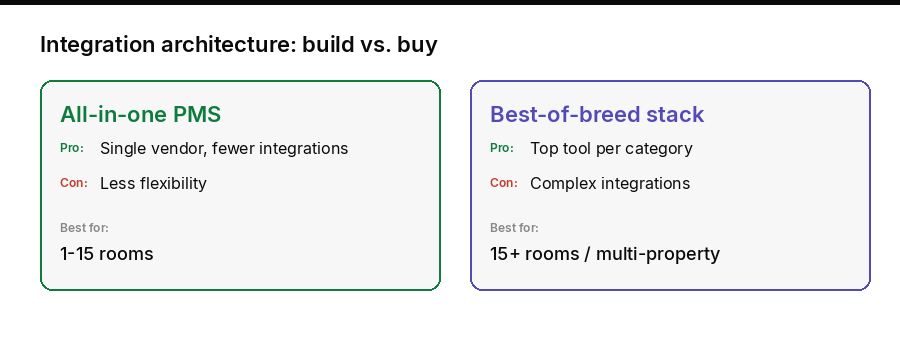
Why? Because custom integrations require ongoing maintenance, create dependencies on specific technical resources, and often cost more long-term than subscribing to integrated platforms. The small hospitality market has matured enough that specialized, affordable solutions exist for nearly every function.
The only scenario for custom integration: when a critical gap exists between available tools and your specific workflow. Even then, validate that the integration cost justifies the benefit.
Integration Priorities for Implementation
You don't need everything simultaneously. Implement in this sequence:
- Phase 1: Foundation (Months 1-2) - PMS that includes basic channel management
- Phase 2: Distribution (Months 3-4) - Dedicated channel manager if not included in PMS, dynamic pricing
- Phase 3: Guest Experience (Months 5-6) - Guest communication platform
- Phase 4: Operations (Months 7-8) - Smart locks and room technology
- Phase 5: Finance (Months 9-10) - Accounting integration and reporting tools
Staggered implementation prevents operational disruption and allows your team to learn each system thoroughly before introducing the next.
Budget Considerations for Small Hotels
For a 30-room hotel, realistic monthly technology costs in 2026 breakdown as follows:
- PMS with Channel Management - €200-400/month
- Dynamic Pricing - €100-200/month (often bundled)
- Guest Communication Platform - €150-300/month
- Smart Locks & IoT - €50-150/month (hardware amortization)
- Accounting Integration - €50-100/month
- Contingency/Additional Tools - €100/month
Total estimated monthly cost: €650-1,250
This translates to approximately €22-42 per room per month in technology costs. For context, the revenue uplift from proper rate management alone typically exceeds this cost by a factor of 10 or more.
Key Insight: The most expensive technology stack is the one that doesn't work. Choose systems your team will actually use, ensure they integrate properly, and prioritize ease of use over feature richness. A 70% feature implementation of user-friendly software outperforms 100% of a complex system nobody uses correctly.
Future-Proofing Your Tech Stack
Technology evolves rapidly, but your tech stack decisions shouldn't require complete overhauls every two years. Build in flexibility by:
- Choosing cloud-based solutions that receive automatic updates
- Prioritizing systems with open API architectures and documented integrations
- Avoiding long-term contracts that lock you into outdated technology
- Planning quarterly reviews of tool effectiveness
Conclusion: Building Your Competitive Advantage
Small hotels can't compete with large chains on property size or amenities. But you can absolutely compete on technology-enabled guest experience, operational efficiency, and revenue optimization. The technology infrastructure available to small properties in 2026 is genuinely world-class—more powerful than systems large chains used just five years ago.
The key is implementing thoughtfully, integrating thoroughly, and training your team effectively. A well-executed tech stack is the difference between a property that merely survives and one that thrives financially and operationally.
Ready to Optimize Your Hospitality Technology?
I work with small hotels throughout Cyprus and Greece to implement technology strategies that drive revenue and efficiency. Let's discuss your specific situation.
Schedule a Consultation