
A compelling hotel business plan isn't just a document—it's your roadmap to securing investment, managing operations, and achieving profitability. In 2026, investors are more sophisticated than ever. They demand detailed financial projections, clear market analysis, and credible management teams. This guide walks you through every component of a hotel business plan that genuinely attracts capital.
Why Investors Demand Comprehensive Hotel Business Plans
Hospitality is a capital-intensive industry. A boutique hotel typically requires €500,000 to €2 million in initial investment, while full-service properties demand €5 million or more. Investors are committing substantial resources and want proof that you understand your market, your competition, your financials, and your risks.
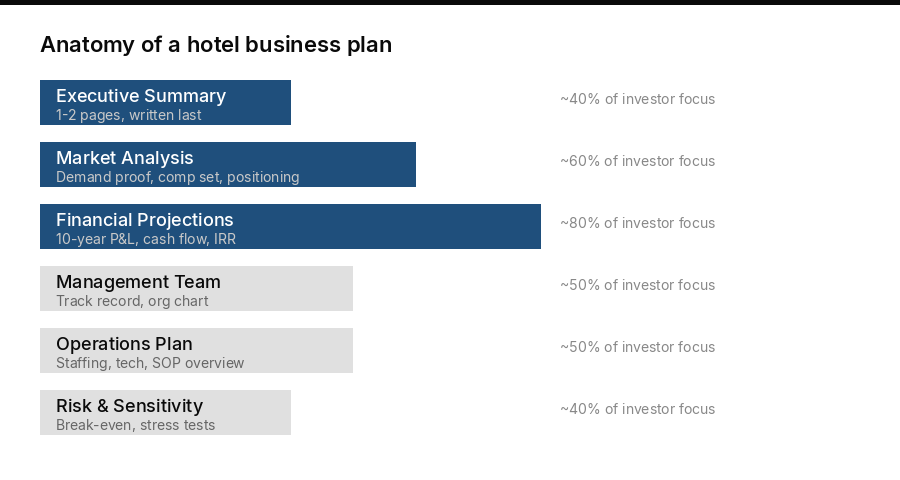
Modern investors evaluate three critical dimensions:
- Market Viability: Is there genuine demand for your concept in your target location?
- Financial Credibility: Are your projections realistic and based on comparable properties?
- Management Capability: Do you have the experience and team to execute?
Without a professional business plan addressing these dimensions, you won't access institutional capital, bank financing, or serious private investors. The document is your credibility filter.
The Executive Summary: Your Most Critical Section
The executive summary is often read first and sometimes alone. Create a compelling one-to-two page overview that immediately establishes investor confidence.
What Must Be Included
Your executive summary should clearly state your hotel concept, target market, location, investment required, and projected financial returns. Investors should understand your value proposition within 90 seconds of reading.
Include a brief competitive advantage statement. Why will your hotel succeed where others might not? This might be your location advantage (beachfront), your target market (luxury business travelers), your unique positioning (eco-boutique), or your operator experience.
Most importantly, specify your return on investment (ROI) and timeline. If your property requires €1.5 million and you project 15% annual returns stabilizing by year three, state that clearly. Investors evaluate opportunity cost—your returns must compete with alternative investments.
Market Analysis: Proving Demand, Not Hoping for It
This is where many hotel business plans fail. Operators assume demand without proving it. Investors notice immediately.
Start with Market Sizing
Quantify your addressable market. If you're developing a 40-room business hotel in Athens, how many business travelers visit annually? What percentage would you realistically capture? Use government tourism statistics, industry reports from Greek Tourism Organization, and comparable property data.
For Mediterranean and Cyprus markets, leverage these data sources: Cystat for Cyprus statistics, INSETE for Greek tourism data, and UNWTO for regional trends. Show that you've researched real market size, not assumed it.
Competitive Landscape
Map 8-12 direct competitors. Document their room count, average daily rate (ADR), occupancy rate, amenities, guest ratings, and positioning. Where does your property fit? Your competitive analysis should demonstrate you've identified white space—an underserved market segment or pricing tier.
If you're positioning as a mid-luxury beachfront hotel in Paphos, show occupancy and ADR for genuinely comparable properties — and say where the figures came from. This is where most plans get picked apart. Two things to know before you write this section:
- No Cyprus hotel ADR is published by any statistics office. Cystat and the Deputy Ministry publish arrivals, revenue and per-capita expenditure but not rate data, and STR/CoStar does not cover Cyprus in its public releases. A credible ADR assumption therefore has to come from your own comp-set research, a paid benchmark subscription, or booking-engine data — and you should say which.
- Occupancy data does exist, but read it carefully. Eurostat puts net occupancy for Cyprus hotels at 72.4% of bed-places in 2024 (Eurostat tour_occ_anor) — but that is national, all categories, and annual. It is not a Paphos figure and not a segment figure. Recent conditions have also diverged sharply: PASYXE reported Paphos occupancy near 70% in June 2026 against an expected 90%+ (Kiprinform), and the hoteliers' association put Easter 2026 occupancy at 25–45% (Cyprus Mail).
An investor is not looking for an optimistic number. They are looking for a number you can defend and a source you can name.
Demand Drivers
Document specific reasons demand exists for your concept:
- Tourism growth trends (is international visitor volume to your destination increasing?)
- Business travel patterns (conference centers, corporate headquarters nearby?)
- Seasonality analysis (average occupancy by month; how will you manage off-season?)
- Development pipeline (new attractions, transportation, business activity coming?)
In Cyprus specifically, highlight the increasing focus on experiential tourism, the growing wellness travel segment, and the year-round appeal of Mediterranean destinations. Be careful with demand claims: total arrivals reached 4.53 million in 2025, up 12.2% on 2024 (Cystat), but that growth is overwhelmingly leisure. Business travel has been flat — 6.3% of arrivals in 2019 and 6.3% in 2023, meaning business arrivals actually declined slightly over that period (EU Tourism Transition Pathway, using CYSTAT-DB). If your plan leans on corporate demand, an investor will check that. Cite the segment you are actually relying on, not headline arrivals.
Financial Projections: Credibility Through Comparables
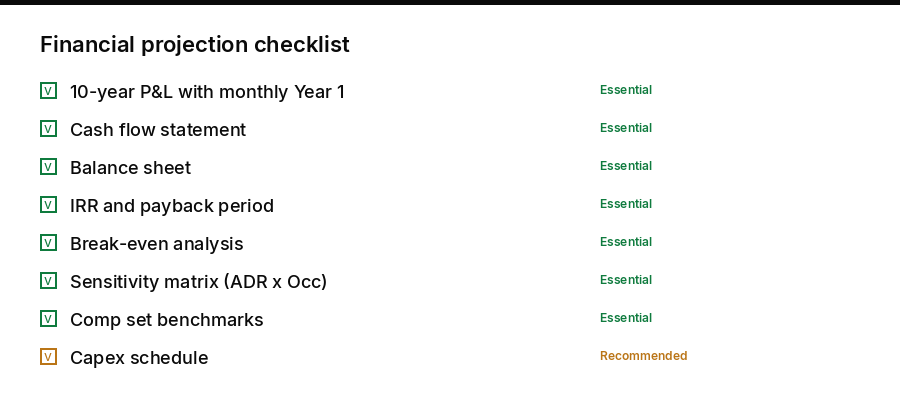
Financial sections require three components: historical comparables, your projections, and sensitivity analysis.
Benchmark Your Numbers
Your projected revenues, operating expenses, and margins must align with comparable properties. If you project 70% average occupancy and €200 ADR for a mid-range hotel, show comparable properties achieving similar metrics. Industry benchmarks for European hotels typically show:
- Labor costs: 28-35% of revenue
- Food and beverage costs: 28-32% of revenue (for properties with F&B)
- Utilities, maintenance, and other operating costs: 15-20% of revenue
- Gross operating profit margin: 35-45% (varies by category)
If your projections differ significantly, justify why. "We'll achieve higher margins through technology" or "Our targeting of corporate accounts reduces marketing cost" are valid explanations only if backed by specific operational plans.
Include Five-Year Projections
Project revenues, expenses, EBITDA, and cash flow for five years. Year one typically shows lower occupancy as you build market presence (assume 50-60% for new properties). Years two and three show ramp-up to stabilized occupancy (65-75%). Years four and five show mature operations.
Most importantly, show when the project achieves positive cash flow and cumulative payback. Investors need to know when they recover capital and when the property generates returns.
Sensitivity Analysis
Prove you understand downside scenarios. Show financial impact if occupancy is 10% lower than projected, if ADR declines by 15%, or if operating costs increase by 20%. This demonstrates risk awareness and planning discipline.
For properties in economic cycles or tourism-dependent regions like Cyprus, sensitivity scenarios are essential. Show that even with 15-20% occupancy declines, the property maintains positive EBITDA by year three.
Management Team: Where Credibility Is Earned
Investors invest in people, not just properties. Your management team section must demonstrate hospitality expertise, business acumen, and local market knowledge.
Key Positions and Experience
Detail the General Manager, Director of Sales and Marketing, Chef or F&B Director (if applicable), and CFO or Finance Manager roles. For each, provide:
- Professional background and hospitality credentials
- Relevant property experience (include property size, category, markets managed)
- Specific achievements (revenue growth, occupancy improvements, operational excellence)
- Local market knowledge and relationships
If you're developing a hotel in Cyprus, having a GM with 10+ years managing Mediterranean properties and existing relationships with tourism boards, travel agents, and local businesses significantly increases investor confidence.
Advisory Board
Include 2-4 advisors: perhaps a tourism industry expert, a local government or economic development official, a hospitality finance specialist, and someone with destination knowledge. Advisors provide expertise gaps and local credibility.
Operations Plan: Proving Execution Capability
This section demonstrates how you'll actually run the property. Include:
Organizational Structure
Show department organization, staffing levels, and reporting relationships. A 60-room hotel typically requires 35-45 full-time equivalent staff across housekeeping, front office, maintenance, F&B, and management. Detail your staffing plan and salary expectations, as labor is your largest controllable expense.
Sales and Marketing Strategy
Document how you'll achieve occupancy projections. Will you focus on corporate accounts, travel agencies, online distribution, or direct bookings? What's your target customer profile? How will you differentiate from competitors?
Be specific: "We'll secure 40% of occupancy through corporate partnerships with local businesses and conference centers, 35% through Booking.com and Expedia at 12-15% commission, 15% through travel agent relationships, and 10% through direct website bookings." This shows distribution channel strategy, not hope.
Quality and Service Standards
Detail service delivery standards, quality assurance processes, and guest experience commitments. Will you pursue specific certifications or ratings (Green Key for sustainability, AA ratings, etc.)? These demonstrate commitment to excellence and can justify premium positioning.
Cyprus and Mediterranean Market Considerations
Properties in Mediterranean and Cyprus markets face specific dynamics that professional plans address:
Seasonality Management
Summer tourism peaks (June-September) while winter occupancy drops significantly. Your business plan must address off-season revenue strategies. This might include corporate retreats, wellness packages, winter events, or positioning for winter sun market. Show realistic year-round occupancy and how you'll optimize revenue per available room (RevPAR) across seasons.
Regulatory Environment
Cyprus hotel development involves licensing from Cyprus Tourism Organization, environmental approvals, labor law compliance, and potentially EU regulations on short-term rentals. Professional plans acknowledge regulatory context and timeline implications. Delays in licensing add 6-12 months to timelines and capital costs.
Competitive Context
Mediterranean hospitality is increasingly fragmented. Airbnb, vacation rentals, and villa tourism compete with hotels. Your plan should explain how a traditional hotel concept differentiates and captures market share despite alternatives. Perhaps your all-inclusive packages, conference facilities, or loyalty programs create advantages.
Common Mistakes That Repel Investors
After reviewing hundreds of hotel business plans, certain patterns emerge:
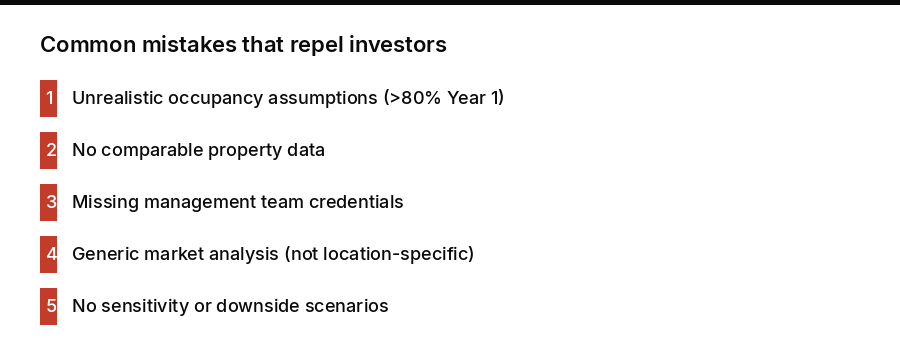
Unrealistic Occupancy Assumptions
New properties achieving 80%+ occupancy immediately are statistical outliers. Mature, well-positioned properties hit this mark. Starting assumptions of 65-70% occupancy (ramping to 75%+ by year three) are credible. Higher projections without specific justification signal inexperience.
Inadequate Competitive Analysis
Plans that dismiss or ignore competition immediately lose credibility. Investors know every market has competitors. Plans that acknowledge competition and clearly explain differentiation are more trustworthy than those pretending no competition exists.
Vague Financial Assumptions
Statements like "we'll achieve strong margins through operational efficiency" without specific cost controls or revenue strategies appear naive. Detailed assumptions about labor cost management, procurement strategies, energy efficiency, and revenue management systems demonstrate sophistication.
Inexperienced Management Team
If you lack hospitality experience, acknowledge it and bring advisors and operational partners who do. Investors assess your ability to execute. If you've succeeded in other industries but not hospitality, this is a red flag requiring mitigation through experienced team members.
Ignoring Technology
In 2026, plans that don't address property management systems, revenue management technology, online reputation management, and guest technology expectations appear outdated. Specify your tech stack and how it supports operations and margin management.
Key Insight: Investors fund properties, but they commit capital to teams with proven competence, clear strategies, and realistic financial expectations. Your business plan is the mechanism to demonstrate all three.
Implementation Timeline and Milestones
Include a detailed timeline from plan approval through opening. This might include 3-6 months for design and permitting, 12-18 months for construction, 2-3 months for pre-opening preparations, and opening by specific quarter. Attach realistic Gantt chart showing dependencies and critical path items.
Cyprus projects often extend 18-24 months from permitting to opening. Investors need to understand this timeline and adjust return projections accordingly. Delayed openings impact payback periods and cash flow timing.
Risk Assessment and Mitigation
Professional plans acknowledge risks and outline mitigation strategies. Key risks for hotel developments include:
- Economic Downturn: Mitigation includes targeting recession-resistant market segments (essential travel, government contracts) and maintaining financial reserves
- Tourism Volatility: Mitigation includes diversified revenue sources (conferences, events, corporate retreats) beyond leisure tourism
- Labor Availability: Mitigation includes competitive compensation, training programs, and staff retention strategies
- Currency Fluctuation: Particularly relevant for Cyprus and Mediterranean properties with mixed-currency revenue streams
- Regulatory Changes: Short-term rental restrictions, labor law changes, or tax increases could impact profitability
Finalizing Your Hotel Business Plan
A professional hotel business plan typically runs 30-50 pages including detailed appendices. It should be polished, professional, and demonstrate the rigor with which you approach the investment.
Before presenting, validate your assumptions with advisors experienced in your specific market. Have hospitality finance specialists review your numbers. Test your plan against potential investor questions: Why this location? Why this concept? Why now? Why you?
Your business plan is your credibility foundation. It's worth the investment to get it right.
Ready to Develop Your Hotel Business Plan?
Karakontis Management specializes in hotel business plans, financial projections, and investment positioning for Mediterranean hospitality properties. Whether you're developing your first property or expanding your portfolio, we provide the strategic planning and financial rigor investors demand.
Get Expert ConsultationSources
Last reviewed: 31 July 2026. Market conditions and platform fees change — verify against the primary source before acting.
- Arrivals of Tourists and Returns of Residents, December 2025 — Cystat
- Top reasons for inbound tourism, Cyprus — EU Tourism Transition Pathway (CYSTAT-DB)
- Net occupancy rate in hotels and similar accommodation — Eurostat (tour_occ_anor)
- Paphos hotel occupancy declines — PASYXE, reported June 2026
- Hotel occupancy dips as bookings remain sluggish — Cyprus Mail, April 2026