
A hotel feasibility study tests whether a proposed hotel project works commercially before capital is committed. It covers site and market assessment, demand analysis, competitive positioning, projected room revenue, operating costs and investment returns. It is not the same as a business plan: a feasibility study asks whether to proceed, a business plan sets out how.
Investing in a hotel property is one of the most significant financial decisions you'll make in the hospitality industry. Before committing capital to a project—whether it's a boutique hotel, resort, or lifestyle property—you need concrete data to guide your investment decision. That's where a hotel feasibility study comes in.
A feasibility study isn't just a document to tick a box for your bank or investors. It's a strategic tool that can save you millions of euros by identifying red flags early, validating your assumptions, and providing the roadmap for success. In this guide, I'll walk you through exactly what a hotel feasibility study should contain, what you'll pay for one in the Mediterranean market, and how to use it to make better investment decisions.
What Is a Hotel Feasibility Study?
A hotel feasibility study is a comprehensive analysis that evaluates whether a proposed hotel project is viable from financial, operational, and market perspectives. It answers the critical question: Can this hotel make money?
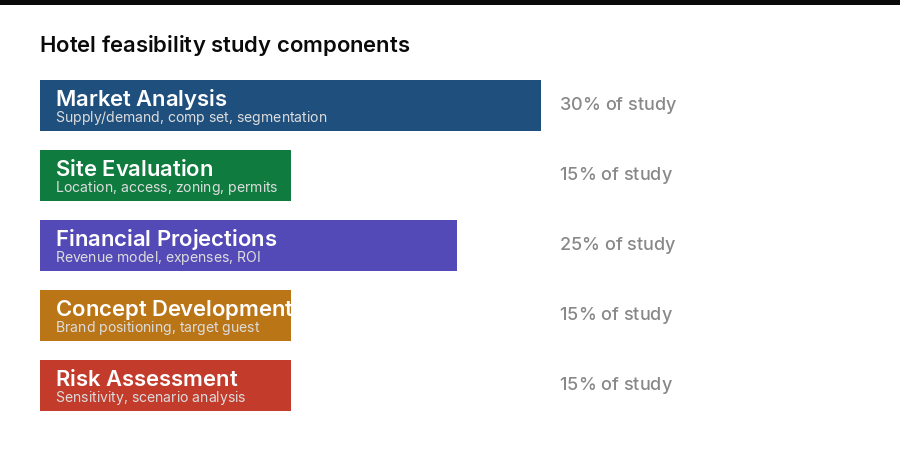
More specifically, a feasibility study examines:
- Market demand in the proposed location
- Competitive landscape and positioning opportunities
- Site-specific advantages and constraints
- Projected revenues based on realistic occupancy and rate assumptions
- Operating costs and staffing requirements
- Capital expenditure needs and ROI projections
- Financing viability and debt service coverage ratios
- Risks and mitigation strategies
The output is a 50-200 page report that gives you a clear picture of your project's financial potential and the assumptions supporting that projection.
When Do You Need a Hotel Feasibility Study?
Not every hospitality project requires a full feasibility study, but several scenarios absolutely demand one:
Before Significant Capital Commitment
If you're planning to invest over EUR 5 million, a feasibility study is non-negotiable. Banks won't lend without one, and neither should you commit capital.
For New Market Entry
Expanding into a destination you don't know? A local study reveals market dynamics you might miss. This is especially valuable for Cyprus investors exploring Greek islands, or European investors entering Mediterranean markets.
When Lenders or Investors Require It
Any institutional financing or equity investment will depend on feasibility study results. It's required—not optional.
For Conversion Projects
Converting a historical villa, office building, or residential property into a hotel involves unique operational and market considerations that a study must analyze.
Before Land Acquisition
Making a land purchase decision without understanding whether that land can support a viable hotel is extremely risky. A feasibility study based on site analysis should inform your land valuation.
Key Components of a Hotel Feasibility Study
1. Executive Summary
This is your study at a glance: project overview, key assumptions, and financial conclusions. Busy investors and lenders often read only this section, so it must be clear and compelling.
2. Market Analysis
A thorough market analysis examines:
- Demand drivers: Tourism arrivals, seasonal patterns, average length of stay, visitor demographics
- Source markets: Which nationalities visit? What brings them?
- Trends: Is tourism growing or declining? Are preferences shifting (experiential travel, sustainability, technology)?
- Market segments: Leisure vs. business travelers, luxury vs. budget, families vs. couples
For Mediterranean properties, this includes analyzing EU tourism recovery, seasonal volatility, and emerging destination trends.
3. Competitive Analysis
You must understand your competition:
- Identifying direct competitors (similar property type, target market, price point)
- Analyzing their occupancy rates, average daily rate (ADR), and revenue per available room (RevPAR)
- Understanding their strengths and weaknesses
- Identifying your positioning opportunity
A good feasibility study includes a competitive set matrix showing at least 8-15 comparable properties with current performance data.
4. Site Analysis
Physical characteristics matter enormously:
- Location relative to demand generators (airports, city centers, attractions)
- Site accessibility and visibility
- Infrastructure availability (utilities, water, waste management)
- Zoning compliance and regulatory constraints
- Environmental considerations
- Space efficiency and architectural constraints
5. Financial Projections
This is the heart of the study—detailed 10-year projections including:
- Revenue assumptions: Room nights sold, ADR, F&B revenue, other income
- Operating expense budgets: Staff, utilities, maintenance, marketing, insurance, property taxes
- Capital expenditure schedule: Pre-opening FF&E, reserves for replacement
- Debt service: Loan amount, interest rates, amortization schedules
- Key metrics: Occupancy %, ADR, RevPAR, EBITDA, NOI, debt service coverage ratio
6. Sensitivity Analysis
Feasibility studies worth their salt include scenario testing. What happens if occupancy is 10% lower than projected? If costs increase 15%? A good study shows best-case, base-case, and worst-case scenarios.
7. Risk Assessment
Honest analysis of what could go wrong:
- Market risks (seasonality, competition, economic downturns)
- Operational risks (staffing, quality management)
- Financial risks (cost inflation, currency exposure)
- Regulatory and political risks
- Mitigation strategies for each risk identified
8. Recommendations
The consultant's conclusion: is the project go or no-go? If go, under what conditions? What modifications would improve viability?
Hotel Feasibility Study Costs in the Mediterranean
Feasibility study pricing varies significantly based on project complexity and consultant reputation. Here's what you'll typically encounter in Mediterranean markets:
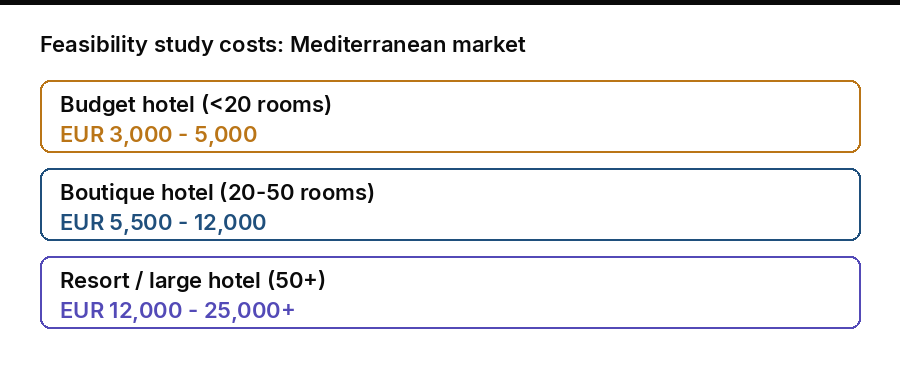
| Study Type | Project Value | Typical Cost (EUR) | Timeline |
|---|---|---|---|
| Preliminary Assessment | EUR 2-5M | EUR 8,000-15,000 | 3-4 weeks |
| Standard Study | EUR 5-20M | EUR 20,000-40,000 | 6-8 weeks |
| Comprehensive Study | EUR 20M+ | EUR 40,000-80,000+ | 10-16 weeks |
| International Consultant | EUR 20M+ | EUR 60,000-150,000+ | 12-20 weeks |
Fee guidance here is drawn from our own quoting experience in Cyprus and Greece rather than from any published schedule — no advisory firm publishes one, and there is no industry survey we are aware of. In our experience, mid-market Cyprus projects fall in the EUR 25,000–50,000 range, and Greek island properties in the EUR 20,000–35,000 range depending on accessibility and how much local data has to be gathered from scratch. Treat these as a starting point for your own quotes, not as a market rate.
International consultancies such as HVS, Cushman & Wakefield and JLL sit well above that, and bring global benchmark data and reputational weight that can matter for large institutional investments. None of them publish fees, so treat any specific figure you see quoted online with caution — the only public industry estimate we could find puts feasibility studies at “a few thousand dollars up to as much as $50,000” (SiteMinder), which is itself unattributed. Ask for a written scope and fee before engaging anyone.
Cost as Investment, Not Expense
A EUR 30,000 feasibility study on a EUR 10 million project is 0.3% of project cost. If it prevents a poor investment or helps you optimise financing, that is a rounding error against what it saves. Don't skimp on quality.
Timeline: How Long Does a Feasibility Study Take?
Timeframes depend on consultant availability and data access, but expect:
- Preliminary studies: 3-4 weeks from brief to report
- Standard studies: 6-8 weeks (includes site visits, stakeholder interviews, market research)
- Comprehensive studies: 10-16 weeks for large or complex projects
- International teams: 12-20 weeks due to coordination and coordination requirements
The most time-consuming elements are typically market research (finding comparable data), site investigation, and financial modeling validation. Building in 2-3 weeks for your team's feedback and revisions is realistic.
Who Should Commission a Feasibility Study?
Property Owners/Developers
If you own land or an existing property you want to develop or convert, commissioning a study before investing in design or permitting is smart strategy.
Institutional Investors
Real estate funds, pension funds, and institutional investors absolutely require feasibility studies before any hotel commitment.
Banks and Lenders
Many lenders require independent feasibility studies (separate from the applicant's consultant) to validate the financial projections.
Hotel Operators
Brands considering new territories or properties commission studies to validate expansion opportunities.
Equity Investors
If you're raising capital from external investors, they'll demand a professional feasibility study before committing funds.
Feasibility Study vs. Business Plan: What's the Difference?
These terms are often confused, but they serve different purposes:
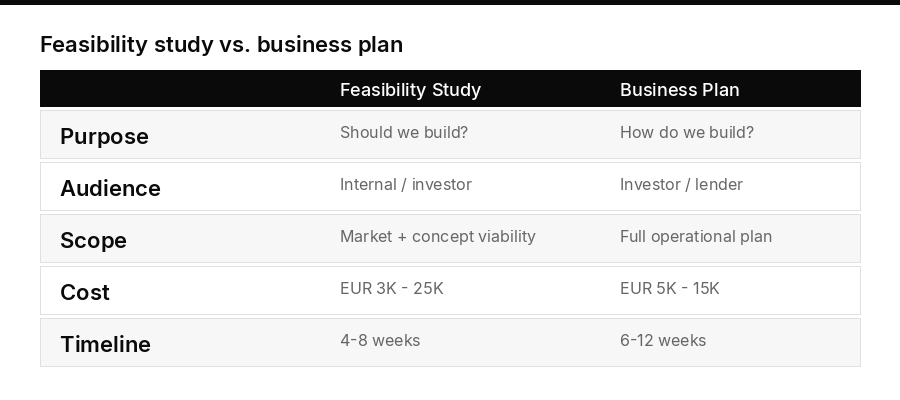
A feasibility study answers: Is this project viable? It's analytical, objective, and typically commissioned by a third party (lenders, investors, acquirers). It examines whether the numbers work and under what assumptions.
A business plan answers: How will we operate and grow this hotel? It's strategic and operational, usually created by management or ownership. It details day-to-day operations, marketing strategy, staff structure, and growth trajectory once the hotel is operational.
You need both. The feasibility study validates the opportunity exists; the business plan details how you'll execute it.
Red Flags: When a Feasibility Study Says "No"
A professional consultant will sometimes recommend against a project. Watch for these red flags:
- Debt Service Coverage Ratio below 1.25x: The hotel won't generate enough cash to reliably cover debt payments
- Occupancy assumptions above market norms: If the study assumes 75% occupancy but competitors average 50%, assumptions are unrealistic
- Operating costs below industry standards: "We'll operate on 25% costs" is a fantasy. Mediterranean hotels typically run 35-45% costs
- Payback period exceeding project timeline: If it takes 15 years to recover investment in a 10-year financial model, it's not viable
- Negative net present value: If the present value of cash flows doesn't exceed the initial investment, the project destroys value
- Limited competitive differentiation: If your hotel is similar to 20 other properties with no clear advantage, margins will be thin
- Regulatory or zoning uncertainty: Feasibility assumes you can get the licenses and permits required—if that's questionable, the project is risky
The hardest part of any feasibility study is delivering a "no" when investors want to hear "yes." A consultant who always says the project works is not being objective. Trust studies that acknowledge risks and provide realistic numbers.
How to Use Your Feasibility Study
Once you have the study in hand, it's not just a document to show lenders. Use it strategically:
- Negotiate land price: If the study shows limited hotel viability, that should reduce your land valuation offer
- Refine your business model: Maybe you need fewer rooms, more F&B focus, or different target markets
- Optimize capital structure: If debt service coverage is tight, consider more equity or different financing terms
- Set operational targets: Use the study's assumptions as your first-year KPI benchmarks
- Identify partnerships: If the study shows operational complexity, you may want a branded operator partner
- Plan contingencies: The risk assessment should inform your reserve funds and mitigation strategy
Conclusion
A hotel feasibility study is not an optional luxury—it's the foundation of responsible hotel investment. At EUR 20,000-50,000, it's a small insurance premium against the risk of investing millions in a property that doesn't work.
The study tells you whether your assumptions are realistic, whether lenders will believe your numbers, and whether the project deserves your capital. In Mediterranean markets where seasonality and economic volatility are real factors, this analysis is especially valuable.
Choose a consultant with local market knowledge, hospitality industry experience, and a track record of objective analysis. The fee matters less than the quality of insights. And if the study recommends against your project? That's not failure—that's a million-euro lesson learned for a EUR 30,000 investment.
Need Expert Guidance on Your Hotel Project?
Whether you're evaluating a feasibility study, planning a new property, or optimizing an existing hotel, our consulting services can guide your decision-making process.
Get in TouchSources
Last reviewed: 31 July 2026. Market conditions and platform fees change — verify against the primary source before acting.