
Operating a short-term rental in Cyprus legally means registering the property, displaying the registration number on every listing, meeting municipal licensing and building-safety requirements, declaring rental income for tax, and following guest-registration rules. Penalties apply to unregistered operation, and the framework has been tightening through 2025–26.
The short-term rental (STR) market in Cyprus has experienced remarkable growth over the past decade, transforming the island's hospitality landscape and creating significant economic opportunities for property owners. However, this rapid expansion has also brought increased regulatory scrutiny and the need for property operators to understand the complex web of licensing requirements, tax obligations, and compliance standards.
As President of the Cyprus Short Term Rental Association (CSTRA), I've worked extensively with operators across the island to navigate these regulations. This comprehensive guide aims to demystify the current regulatory framework and help you operate your property legally and profitably.
Understanding the Current Regulatory Landscape
Cyprus has undergone significant regulatory evolution regarding short-term rentals. For many years, the sector operated with minimal oversight, but this has changed dramatically. Today, operators must engage with multiple government agencies and comply with various regulatory requirements at both national and local levels.
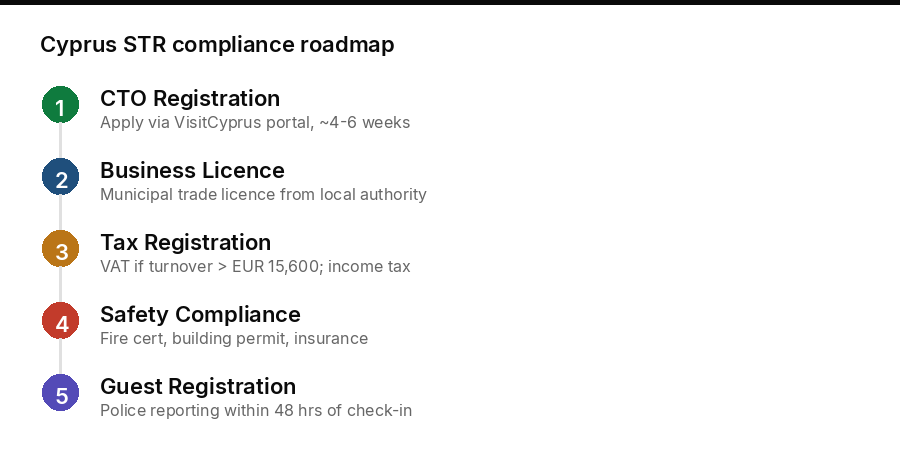
The regulatory framework is designed to balance several competing interests: protecting the interests of long-term renters and permanent residents, ensuring fair taxation, maintaining building safety standards, and supporting the legitimate hospitality sector. Understanding these objectives helps clarify why certain requirements exist and why compliance is not negotiable.
The Critical CTO Registration Requirement
The registry is run by the Deputy Ministry of Tourism, which took over the functions of the former Cyprus Tourism Organisation (CTO) in 2019 (Deputy Ministry of Tourism — registration of self-service accommodation). One of the most fundamental requirements for STR operators is registering with the Cyprus Tourism Organization (CTO). This registration is not optional—it is a legal mandate for anyone offering accommodation for short-term rental in Cyprus.
The CTO registration process involves several steps. First, you must provide documentation of your property, including proof of ownership or rental authorization from the owner. You'll need to submit a detailed floor plan, safety certificates, and proof of liability insurance. The CTO conducts inspections to verify that your property meets minimum safety and quality standards before approval.
The CTO classification system categorizes properties based on amenities and services. Properties are typically classified as either 3-star, 4-star, or 5-star establishments. Your classification affects your compliance obligations and, importantly, the prices you can charge. Higher classifications require more amenities and services but may justify premium pricing.
Key Point:
Operating a short-term rental without CTO registration is illegal and can result in penalties, forced property closure, and significant fines. The CTO actively monitors listings on major platforms to identify unregistered properties.
Once registered, you receive an authorization number that must be displayed on all your listings. This number serves as proof of compliance and is essential for your legitimate operation. The registration must be renewed annually, and you should plan for this well in advance to avoid disruptions to your business.
Tax Obligations: VAT, Income Tax, and Professional Licenses
Tax compliance is one of the most misunderstood aspects of STR operations in Cyprus. Many operators underestimate their tax obligations, sometimes with serious consequences. Understanding these obligations is critical for both compliance and proper business planning.
Value Added Tax (VAT)
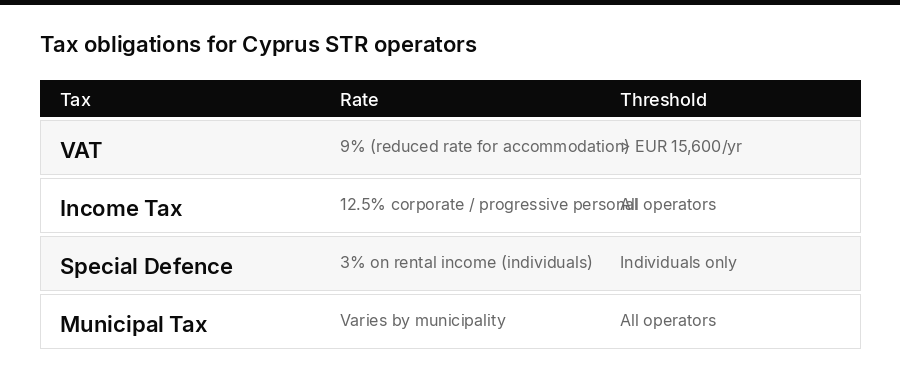
If your taxable turnover from short-term rentals exceeds €15,600 in any 12-month period, you are required to register for VAT, and you have 30 days from crossing the threshold to do so. Once registered, accommodation falls under Cyprus's reduced 9% VAT rate rather than the 19% standard rate (Cyprus VAT rates and thresholds). Note that VAT treatment can differ between registered tourist accommodation and bare property letting — confirm your own position with your accountant. This is not a tax you keep—it must be remitted to the tax authorities on a quarterly basis.
Many operators incorrectly include VAT in their quoted rates without properly accounting for it, effectively operating at a loss. You must clearly separate your service revenue from VAT in your accounting. The VAT registration threshold is reviewed annually, so you should confirm the current threshold with the Cyprus Tax Department (CED).
Below the VAT threshold, you have the option to voluntarily register, which can be beneficial if you have significant expenses and want to reclaim VAT on those expenses. This calculation is complex and requires professional advice.
Income Tax and Professional License
All income from short-term rental activities is subject to personal income tax. You must declare all rental income on your annual tax return. The tax rate depends on your total income and filing status, but currently ranges from 0% to 35% depending on your income bracket (Cyprus personal income tax bands).
If you own multiple properties or operate your STR business as a primary activity, you may be required to obtain a professional/commercial license from your local municipality. This license formalizes your business status and ensures compliance with local zoning regulations.
Many operators fail to properly declare income, assuming that cash payments go unreported. The Cyprus tax authority has become increasingly sophisticated in identifying unreported income, particularly given the detailed records maintained by booking platforms like Airbnb and Booking.com, which are required to provide booking information to tax authorities.
Provisional Income Tax
Once you're established as a self-employed person or business owner, you may be required to pay provisional income tax based on your previous year's income. This amount is due in quarterly installments and is later reconciled with your actual tax liability. Failing to account for this obligation can create severe cash flow problems.
Municipal Licensing and Local Regulations
Beyond national requirements, each municipality in Cyprus has its own regulatory framework for short-term rentals. These local regulations can vary significantly, and it's essential to understand the specific requirements in your area.
Many municipalities require a separate municipal license or have specific zoning restrictions regarding STR operations. Some areas have restrictions on the number of properties that can operate as STRs in a single residential area, or restrictions on the number of STRs per owner within municipal boundaries.
Additionally, municipal noise ordinances and neighborhood regulations apply to STR operations. Complaints from neighbors about noise, parking issues, or excessive guest activity can lead to enforcement action by the municipality. These infractions can be serious, potentially leading to property closure orders.
Before purchasing a property for STR purposes, verify with your municipality that short-term rental use is permitted. Some communities have explicitly prohibited STRs to preserve neighborhood character and housing availability for residents. Operating in violation of these prohibitions can result in forced closure.
Building Safety and Insurance Requirements
Guest safety is a paramount regulatory concern, and operators must comply with several building safety requirements.
Safety Standards
Your property must meet European safety standards for accommodation facilities. This includes adequate fire safety equipment, functioning smoke detectors, fire extinguishers, and clearly marked emergency exits. The CTO inspection process verifies these requirements, and you must maintain these standards throughout your operation.
Electrical systems must be safe and in good condition. Regular maintenance and professional inspections are advisable. Plumbing systems must be safe and meet health standards. Swimming pools, if present, must comply with safety regulations.
Older properties may require significant upgrades to meet modern safety standards. The costs of these upgrades can be substantial, so this is an important consideration when evaluating property suitability for STR use.
Liability Insurance
Comprehensive liability insurance is mandatory for CTO registration and is essential for protecting yourself from guest injury claims. This insurance must cover bodily injury and property damage that guests might suffer while staying at your property.
Standard property insurance policies typically exclude short-term rental use. You must specifically obtain hospitality liability coverage. Failure to maintain adequate insurance can result in personal liability if a guest is injured, and your CTO registration will be revoked if you cannot demonstrate active insurance coverage.
Operational Compliance and Guest Registration
Beyond licensing and taxation, several operational requirements must be met.
You are required to maintain accurate records of all guests, including their names, passport numbers, dates of stay, and booking platform used. These records must be maintained for a minimum of three years and provided to authorities upon request. This requirement is taken seriously by both tax and tourism authorities.
Your property must have proper rental agreements or terms and conditions governing guest behavior. These should address noise policies, maximum occupancy, house rules, and procedures for handling damages. Clear communication of expectations reduces disputes and protects your interests.
You must respond promptly to regulatory inquiries from the CTO, the Tax Department, or municipal authorities. Failure to cooperate with regulatory investigations can result in additional penalties and may trigger more intensive scrutiny of your operations.
Current and Upcoming Regulatory Changes
The regulatory environment is evolving continuously. Several important changes are on the horizon that operators should be aware of.
The European Union is increasingly focused on regulating short-term rentals at the national level. Cyprus, as an EU member state, is implementing directives aimed at addressing housing availability, tax compliance, and community impact concerns. These may include stricter registration requirements, lower VAT thresholds, and enhanced monitoring capabilities.
Many proposals under discussion include mandatory registration numbers on all platforms, geolocation tracking of STR properties to prevent unauthorized clusters in residential areas, and potentially mandatory community impact assessments for operators with multiple properties.
The CTO has indicated plans to strengthen enforcement mechanisms and increase inspections. The tax authority continues to improve data-sharing arrangements with booking platforms, making tax evasion increasingly risky and impractical.
As President of the CSTRA, I'm actively engaged with government stakeholders to ensure that new regulations are balanced, proportionate, and encourage legitimate operator compliance while maintaining Cyprus's competitive position in the European STR market.
Penalties for Non-Compliance
Understanding the consequences of non-compliance is important for making informed business decisions. The penalties can be severe.
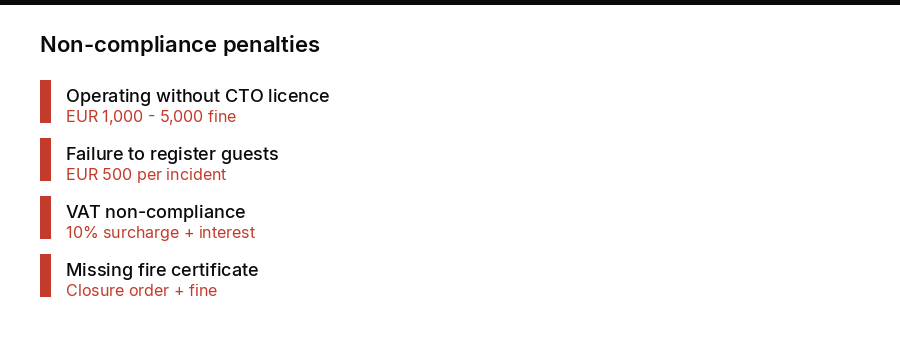
Operating without registration is an offence under the law regulating the establishment and operation of hotels and tourist accommodation. It carries a fine of up to €5,000 or up to one year’s imprisonment, and where the offence continues after conviction, a further penalty of up to €200 for each day it persists (Cyprus Mail, April 2025). Booking platforms may also delist unregistered properties once identified.
Tax non-compliance carries even more serious consequences. Undeclared income is subject to penalties of 10-50% of the unpaid tax, plus interest accruing monthly at significant rates. Criminal prosecution is possible for deliberate tax evasion, which could result in substantial prison sentences and permanent reputational damage.
Failure to maintain proper insurance, safety standards, or guest records can result in administrative fines, property closure orders, and personal liability for guest injuries or damages. A single serious incident can bankrupt an operator who lacks adequate insurance.
Reality Check:
The true cost of non-compliance is far higher than the cost of compliance. Investing in proper registration, taxation, insurance, and maintenance is not an optional expense—it's the foundation of sustainable operations.
Best Practices for Compliant Operations
To operate successfully within the regulatory framework, implement these essential practices:
- Document Everything: Maintain organized records of all registrations, licenses, insurance certificates, inspection reports, guest records, and financial transactions. Digital organization systems prevent loss and enable quick responses to regulatory inquiries.
- Engage Professional Help: Work with a qualified accountant experienced in hospitality operations to ensure proper tax compliance and financial management. The cost of professional advice is negligible compared to the cost of fixing compliance problems.
- Maintain Safety Standards: Conduct regular property inspections, maintain all safety equipment, and address maintenance issues promptly. Schedule professional electrical and plumbing inspections annually.
- Stay Informed: Regularly check the CTO website and municipal government announcements for regulatory updates. Subscribe to industry communications from the CSTRA for updates affecting the broader operator community.
- Plan for Renewals: Create a calendar system to track renewal deadlines for CTO registration, municipal licenses, and insurance policies. Failing to renew creates gaps in compliance that are difficult to remedy.
- Price Appropriately: Set your rental rates to cover all costs including VAT, taxes, insurance, maintenance, utilities, and platforms fees. A rate that doesn't cover these costs is unsustainable.
- Communicate Clearly: Maintain transparent communication with guests regarding house rules, policies, and expectations. Clear communication prevents disputes and protects your interests.
The Path Forward for Cyprus STR Industry
Cyprus's short-term rental market represents a significant economic opportunity, but that opportunity comes with regulatory responsibility. The operators who will thrive in the coming years are those who view compliance not as a burden, but as a competitive advantage.
A well-regulated market protects legitimate operators from unfair competition from non-compliant businesses. The CSTRA is committed to working with government authorities to develop regulatory frameworks that are fair, transparent, and support the growth of quality hospitality experiences across the island.
The key insight is this: operating legally is not more expensive than operating illegally if you account for all the risks and potential penalties. In fact, legal compliance is often more profitable in the long term because it enables you to operate with confidence, access legitimate banking and insurance products, and build sustainable business growth.
If you're currently operating without proper registration or have questions about compliance, the time to address these issues is now, not after a regulatory inspection or tax audit. Taking proactive steps to align with regulations protects your investment and ensures a sustainable future for your business.
Need Expert Guidance on STR Compliance?
As an operator or property owner in Cyprus, navigating the regulatory landscape can be complex. I offer comprehensive consulting services to help you understand your obligations, streamline your operations, and ensure full compliance with all applicable regulations.
Schedule a ConsultationSources
Last reviewed: 31 July 2026. Regulations and tax rates change — verify against the primary source before acting, and take professional advice on your own position.