
If you run a boutique hotel or a serious short-term rental portfolio in Cyprus, OTA commissions are probably your single largest controllable marketing expense, and they are moving against you. Airbnb is consolidating its split-fee structure into a single 15.5% host-paid service fee (Airbnb); hosts inside the EEA had until 13 October to adjust their pricing, and traditional hospitality listings and anyone using property-management software were already on the host-only fee (Airbnb service fees). Booking.com, by contrast, publishes no rate at all — its own partner help says commission “depends on your country, property type and the accommodation agreement you signed” (Booking.com Partner Hub), and Preferred Partner and Visibility Booster stack on top. Check your own contract rather than trusting a figure from a blog. Either way, cutting total commission by even five points changes the economics of the property.
This playbook is the concrete version of "get more direct bookings" — specific to Cyprus operators, realistic about small-property constraints, and written for 2026 market conditions. It assumes you already have a live Booking.com and/or Airbnb listing and want to shift the mix.
Why direct bookings matter more in 2026
Three things changed the math for Cyprus operators in the last 18 months. First, OTA commissions crept up across the board — preferred partner programs, genius discounts, and visibility boosters that were "optional" now feel mandatory if you want to appear on page one. Second, direct-to-consumer tools that used to cost tens of thousands of euros (booking engines, channel managers, CDPs) are now available to small operators for a few hundred euros a month. Third, guest behaviour shifted: repeat travellers to Cyprus increasingly search the property name on Google before booking, which gives you a free shot at winning the booking if your direct funnel exists.
The result: a 12-apartment operator in Limassol or a 25-room boutique in Paphos can realistically move from 100% OTA dependency to a 60/40 or even 50/50 mix within 12 months. That 40% to 50% direct share, at mid-market ADRs, typically adds four to seven percentage points to the net margin.
What a direct booking actually costs you
"Direct is free" is a myth that causes bad decisions. A direct booking costs you something — just less than an OTA booking, usually. Before you optimise the channel, do the honest math.
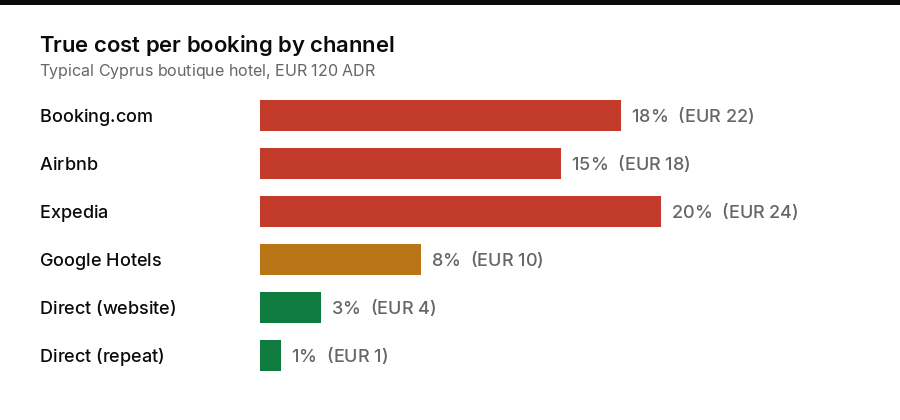
Take a €150 ADR booking as a worked example. Note this is an illustrative rate, not a market average — published estimates put Cyprus short-term rental ADR nearer €118 to €120 (Airbtics, AirDNA), so run the same arithmetic on your own numbers. On Booking.com at a 15% commission that booking loses around €22.50, plus roughly €3 to €5 in payment processing on the gross. Net to you: about €123.
The same booking through your own website, routed through a booking engine like SiteMinder, Cloudbeds, or Little Hotelier, costs roughly: €0.80 to €2 booking engine fee, €3 to €5 Stripe, €0.50 to €2 in amortised SEO and Google Ads spend if you are being disciplined, plus the cost of your own time. Net to you: around €140 to €144.
That is a €17 to €21 swing per booking in your favour — meaningful, but not "free." This matters because it should shape where you invest: in every case where a Google Ads click costs more than €15, you are losing the direct-booking arbitrage. Discipline the spend.
The direct booking stack for Cyprus properties
You need four pieces working together. Missing any of them and direct bookings stall.
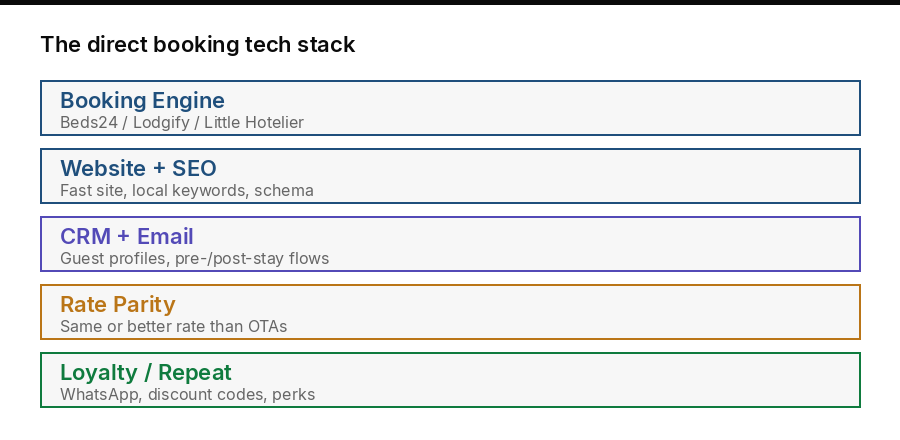
A property website that actually converts
Not a brochure. Not the one your developer built in 2021. A single-page or minimal-pages site with: real photos (not OTA-style wide-angle distortions), a clear location map, specific amenities, recent reviews pulled in from Booking.com or Google, transparent pricing, and a booking widget above the fold on mobile. Cyprus guests book two-thirds of their leisure stays on mobile. If your site is 1.2MB of hero video that loads in four seconds, you have already lost.
A real booking engine
This is where most Cyprus operators get stuck — they have a WordPress site with a "contact us for availability" button. In 2026 that converts at under 1%. You need a proper booking engine connected to your PMS and channel manager: real-time availability, real-time rates, instant confirmation, card capture, and automated confirmation email. For small properties the realistic options are Cloudbeds, Little Hotelier, Hostaway, Guesty, or Lodgify depending on your property type. Budget €150 to €400 per month all-in.
A channel manager with rate parity controls
Without a channel manager you cannot run direct pricing experiments without risking OTA penalties (more on that below). With one, you can offer loyalty discounts, package deals, and length-of-stay discounts on direct only, while maintaining published rate parity with the OTAs.
A minimum marketing layer
Google Business Profile fully completed with real photos and weekly updates, a Google Ads account configured for branded searches at minimum, a Meta Business account connected to Instagram, and a transactional email service (Mailchimp, Klaviyo, or Brevo). None of these cost much. All of them are prerequisites.
Pricing and rate parity without getting delisted
Rate parity clauses are softer than they used to be in the EU — the Digital Markets Act and related national rulings have weakened OTA enforcement meaningfully. But "softer" does not mean "gone." Booking.com still penalises properties that show lower public rates elsewhere by cutting visibility, even where the contractual clause is unenforceable.
The safe playbook in Cyprus in 2026:
- Keep public rack rates identical across your site, Booking.com, Airbnb, and Expedia. Do not race to the bottom on your own site.
- Offer member-only rates behind a free one-click signup on your direct site. A 5% to 10% "member rate" is fair game and not visible to OTA scraping.
- Bundle value, not discount. Add airport transfer, late checkout, a bottle of local wine, or a breakfast credit. These are not rate-parity violations — they are package differences. And they often convert better than a straight discount.
- Use length-of-stay discounts on direct. A 10% discount on seven-plus night stays is defensible everywhere and lifts average length of stay meaningfully.
If you want to go further — running direct-only flash sales or lower public rates — do it with full awareness that you may take a 20% to 40% hit on OTA visibility for a few weeks. Some operators accept that trade. Most should not.
Practical note: In Cyprus, the biggest rate-parity mistake I see is hosts accepting direct WhatsApp bookings at €20 below the OTA rate. Booking.com's rate scanners catch reviews and thank-you posts that reveal the lower rate, and visibility drops within weeks. If you must discount, do it behind a login wall.
Turning OTA guests into direct repeat guests
Your OTA bookings are not wasted — they are your cheapest customer acquisition channel. The job is converting first-stay OTA guests into second-stay direct guests.
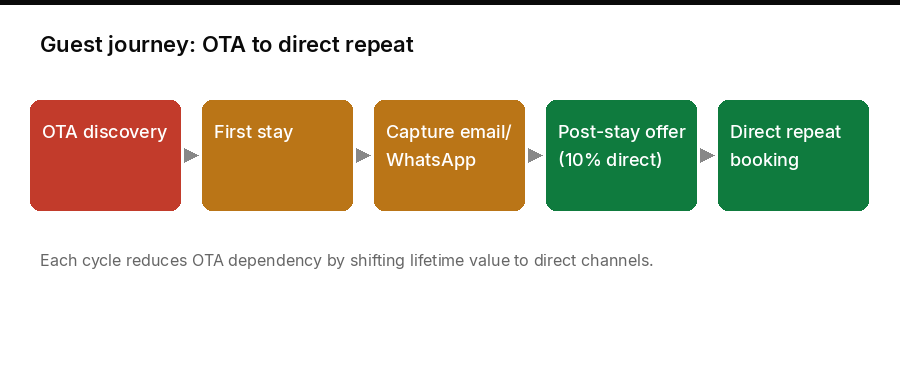
Three things must happen before they check out:
Capture their real email and mobile. OTAs increasingly anonymise contact details (Booking.com's "virtual email," Airbnb's routed messaging). But the in-stay check-in flow — registration form, Wi-Fi portal, welcome email with house rules — is yours. Use it. Every guest should leave a real email address and, with explicit opt-in, a phone number in your database.
Give them a reason to book direct next time. Print a small card in each apartment or room with a direct-booking code — "Stay with us directly next time: 10% off with code [property]-DIRECT, plus late checkout." QR code to your booking engine. Simple, tactile, and it works. Conversion rates on these cards for Cyprus STRs run around 6% to 12% on repeat stays.
Send one post-stay email. Not a sequence of five. One well-written email, sent seven days after checkout, thanking them, asking for a review, and offering the direct discount for their next visit. Cyprus leisure guests repeat-visit at roughly 20% to 30% depending on location and property type. Even a 10% conversion on that second visit is a material margin lift.
This ties directly into what you are already doing for Airbnb listing optimisation — the better your OTA listing converts, the more first-stay guests you get into the funnel.
Google Hotel Ads, metasearch, and paid traffic
For Cyprus boutique hotels specifically, Google Hotel Ads and Trivago are the two metasearch channels that actually move bookings. Airbnb is not yet integrated into standard metasearch, which is an advantage for traditional hotels and licenced STR operators.
Google Hotel Ads. Connect via your booking engine or a metasearch partner like Koddi or Triptease. Commission model (CPA) is typically 10% to 15% — less than Booking.com, and you own the customer. For a mid-size Cyprus boutique, expect Google Hotel Ads to deliver 8% to 15% of total bookings within six months of a clean setup.
Branded Google Ads. The cheapest direct bookings on earth. Bid on your property name. When a guest searches "[your hotel name] Paphos" after seeing you on Booking.com, a €0.30 click from a branded Google Ad can win a €500 three-night booking. Running this is non-negotiable for any property with a distinct name.
Generic paid search. "Apartments Limassol" and similar terms are dominated by OTAs with massive budgets. For small operators, the ROI is almost always negative. Do not compete there.
Meta Ads. Useful for retargeting (visitors who hit your site but did not book) and for seasonal pushes. Not your lead acquisition channel — Google is. Budget 20% to 30% of your paid spend here at most.
Email, WhatsApp, and CRM: the cheapest channel
If you have 2,000 past guests in a properly segmented database, one well-timed email campaign — shoulder-season offer in October, Christmas break availability in November — generates more revenue than most of your paid acquisition spend. And it costs you €30 in Mailchimp fees.
The two non-negotiables:
- GDPR-clean consent. Every contact in your list must have opted in explicitly. Cyprus data protection authority enforcement has tightened in the last two years. Store the consent source, the date, and the IP address for every record.
- Segmentation by stay date and property. A guest who stayed in your Larnaca apartment in July 2025 is a completely different target than a guest who stayed in your Paphos villa in January 2026. Do not blast the whole list with the same offer.
For WhatsApp, the official WhatsApp Business API (via Twilio, 360dialog, or similar) is worth it for properties with 1,000+ guests per year. Direct inquiry response rates on WhatsApp run 3x to 5x higher than email for Cyprus Mediterranean guests, and booking conversion from a WhatsApp conversation is significantly higher than from email.
Local partnerships and corporate accounts
This is the most under-exploited channel for Cyprus boutique operators in 2026.
Corporate accounts. Fintech companies relocating staff to Limassol, forex and software firms in Nicosia, international law and consulting firms with Cyprus offices — all of them have accommodation budgets and none of them want to book through Booking.com. A simple corporate rate sheet (10% off rack, direct invoicing, no deposit), distributed to HR and office managers, can lock in 15% to 25% of your weekday occupancy at zero commission.
Medical and university partnerships. The University of Cyprus, University of Nicosia, and medical tourism operators (fertility clinics, dental, orthopaedic) all need extended-stay accommodation. Cash discounts on 14+ night stays, direct invoicing, and a dedicated phone line convert well.
Wedding and event planners. For villa and aparthotel operators in Paphos and Ayia Napa, a handful of planner relationships can generate 10+ booked weddings per year. Each wedding is usually 8 to 20 rooms for 2 to 3 nights. Pay a 5% to 8% referral fee — still dramatically cheaper than OTA commission on the same revenue.
This ties into the broader Cyprus market dynamics we covered in STR regulations in Cyprus — licenced operators are now strongly preferred by corporate and institutional buyers, and that preference is worth real money on the direct channel.
KPIs and a 90-day rollout plan
Track four numbers monthly. If you only track one, track direct-booking share.
- Direct booking share as a percentage of total bookings, measured by revenue (not room nights). Baseline. Target. Actual. Every month.
- Effective commission rate across the full channel mix — total commission and payment processing divided by total revenue. Your single best indicator of channel-mix health.
- Repeat-guest rate — what percentage of current-month arrivals have stayed before. Ties directly to the post-stay email and loyalty work.
- Cost per direct booking (paid) — total Google Ads plus Meta spend divided by direct bookings attributed to paid. Should stay under 4% of ADR.
A realistic 90-day rollout looks like this:
Days 1 to 30 — Infrastructure. Pick and set up the booking engine. Connect it to your PMS and channel manager. Rebuild the website around a visible above-the-fold booking widget. Set up Google Business Profile, Google Ads account, and Mailchimp with GDPR-clean consent fields. Start collecting guest emails from every arrival.
Days 31 to 60 — Activation. Launch branded Google Ads on property-name searches. Launch Google Hotel Ads via metasearch. Design and print the in-room direct-booking cards. Send your first segmented email to past guests. Begin outreach to 10 to 20 target corporate accounts in your property's catchment area.
Days 61 to 90 — Optimisation. Review the KPI dashboard. Identify the two channels pulling the most weight and double down. Kill anything not producing. Lock in three to five corporate rate agreements. Set targets for the next 90 days.
At the end of 90 days, a properly executed direct-booking rollout for a Cyprus boutique or STR operator typically shows direct share moving from zero to 15% to 25%, effective commission dropping by three to five points, and a working CRM with 300+ opted-in past guests. From there, it compounds.
Want help running this for your property?
Karakontis Management helps Cyprus hotels and STR operators design and execute direct-booking strategy — channel-mix audits, booking-engine setup, corporate account development, and the full 90-day rollout.
Get in touch