
Dynamic pricing sets room rates day by day from real-time demand signals: local events, day-of-week patterns, booking lead time, occupancy on the books and competitor rates. Tools such as PriceLabs, Beyond and Wheelhouse automate the model; the operator tunes the rules so it neither undersells peak nights nor overprices shoulder season.
What is Dynamic Pricing and Why It Matters
Dynamic pricing, also known as surge pricing or yield management, is the practice of adjusting room rates based on real-time demand, market conditions, and competitive landscape. Instead of setting a fixed price for the season, your rates fluctuate daily—sometimes hourly—to maximize revenue and occupancy.
For boutique hotels, dynamic pricing is not just advantageous—it's becoming essential. Unlike larger hotel chains with sophisticated pricing teams and massive datasets, boutique properties must work smarter to compete. In our client work, a well-implemented dynamic pricing strategy has typically added 15–30% to annual revenue without adding a single room or guest — a range drawn from properties we have worked with, not a published benchmark.
The beauty of dynamic pricing lies in its simplicity: charge more when demand is high, lower prices when demand drops. This isn't complicated; it's logical. Yet many boutique hotel operators still rely on static seasonal rates, leaving significant revenue on the table.
Why Boutique Hotels Need Dynamic Pricing
Boutique hotels face unique challenges that make dynamic pricing particularly valuable:
- Limited inventory: With fewer rooms (typically 10-60), each occupied room significantly impacts revenue. A single vacancy can represent 2-10% of daily potential revenue.
- Seasonal volatility: Mediterranean destinations experience dramatic seasonal swings. Summer rates might be 3-4x winter rates, but static pricing can't capture all the micro-opportunities between extremes.
- Local competition: Without brand recognition, you compete on value and personalization. Dynamic pricing helps you stay competitive while maintaining margins.
- Smaller marketing budgets: Dynamic pricing generates revenue from existing customers and market segments you already reach, rather than requiring expensive customer acquisition.
- Guest experience: Optimized pricing means fuller occupancy. Higher occupancy rates create better atmospheres, improved guest reviews, and stronger recommendation patterns.
Pro Tip: A boutique hotel with 25 rooms that increases occupancy from 65% to 78% through dynamic pricing essentially gains the revenue of 3-4 additional rooms without capital investment.
Understanding Mediterranean Seasonality
Cyprus and Mediterranean destinations follow predictable seasonal patterns, but opportunity exists in the nuances:
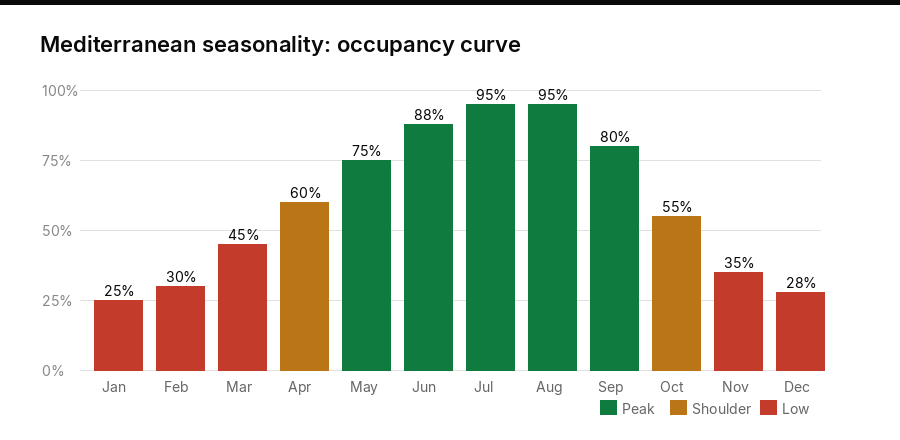
- High Season (June-August): Summer holidays drive peak demand. Prices are highest, but you can still optimize daily rates based on day-of-week, holidays, and booking velocity.
- Shoulder Seasons (April-May, September-October): Easter holidays boost April-May; autumn weather attracts late-summer travelers in September-October. These periods offer excellent rate optimization opportunities.
- Low Season (November-March): Winter tourism focuses on holidays, New Year, and winter sun seekers. December 20-January 10 typically sees increased demand.
- Flash demand events: Unexpected conferences, sporting events, or cultural festivals can create 24-48 hour demand spikes worth pricing into.
Smart boutique operators use data from previous years to anticipate these patterns, then apply dynamic pricing to capture value across all seasons—not just summer peaks.
Booking Curve Analysis
The booking curve shows when guests typically book relative to arrival dates. Understanding your booking curve is crucial for dynamic pricing:
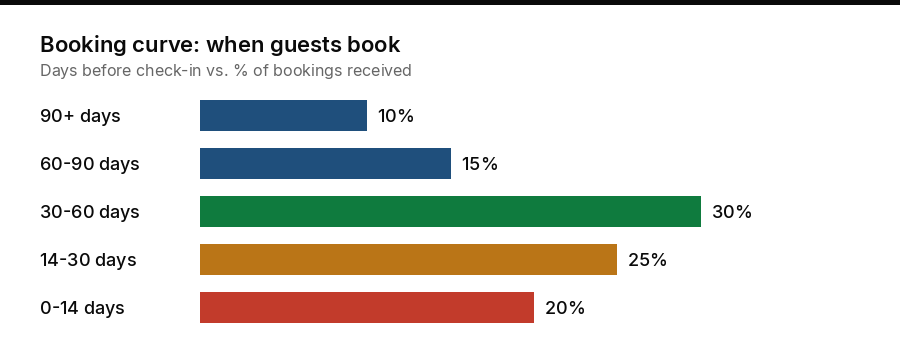
- Early bookers (45+ days ahead): Usually price-sensitive; book well in advance. Lower rates can capture this segment.
- Mid-range bookers (14-45 days ahead): Less price-sensitive; more flexible on timing. Moderate rates apply.
- Last-minute bookers (0-13 days ahead): Highly flexible on dates and property; pay premium rates if availability exists.
Your pricing strategy should encourage optimal booking velocity while maximizing ADR (Average Daily Rate). Advanced systems analyze your specific booking curve to recommend prices automatically.
Dynamic Pricing Tools Comparison
Several platforms serve boutique hotels specifically. Here's how the leading options compare:
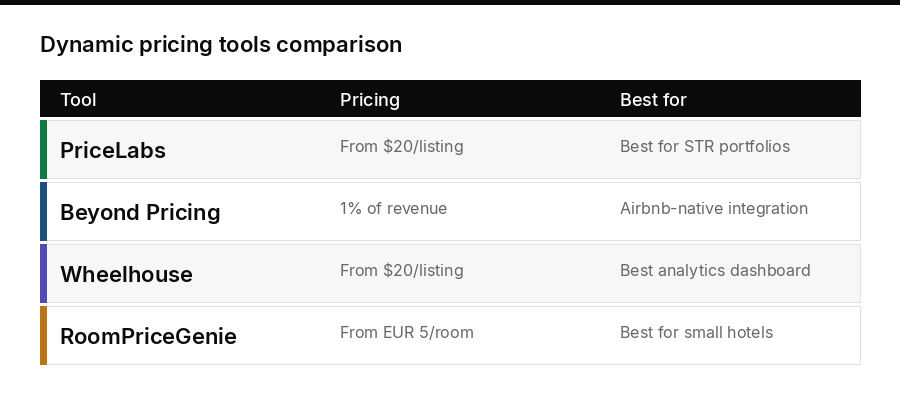
| Tool | Best For | Pricing Model | Key Features |
|---|---|---|---|
| PriceLabs | Multi-property owners, Airbnb/VRBO focus | $0.99 per listing/month or revenue % | AI pricing, competitor tracking, multi-platform integration |
| Beyond | Direct booking focus, European properties | $99-299/month | Channel manager, revenue optimization, white-label options |
| Wheelhouse | Boutique hotels, vacation rentals | 10% of incremental revenue | Smart pricing, market insights, booking curve analysis |
| RMS Pricing Engine | Enterprise, integrated with property management | Custom licensing | Complex algorithms, enterprise support |
| Airbnb Smart Pricing | Airbnb-only properties | Free | Basic automation, limited customization |
Tool Selection Strategy
For properties with 20+ rooms using multiple channels: Beyond or Wheelhouse offer the best integration and support. Beyond excels at direct booking optimization; Wheelhouse provides better market intelligence.
For single property, Airbnb/VRBO heavy: PriceLabs offers excellent value. The low per-listing cost and strong Airbnb integration make it ideal for smaller operations.
For direct booking heavy operations: Beyond's channel manager and revenue management tools create a unified system worth the monthly investment.
Implementation Steps for Boutique Hotels
Rolling out dynamic pricing doesn't require perfect data or months of planning. Here's a practical phased approach:
Phase 1: Baseline Assessment (Week 1-2)
- Collect 12 months of historical booking and revenue data
- Calculate current ADR, occupancy, and RevPAR (Revenue Per Available Room)
- Identify your booking curve patterns
- Document your current pricing strategy
- Analyze competitor rates using tools like RateGain or Trivago
Phase 2: Tool Selection and Setup (Week 3-4)
- Choose one tool based on your property size and booking channels
- Integrate with PMS (property management system)
- Connect to booking channels (OTA, direct booking site)
- Set floor (minimum) and ceiling (maximum) prices
- Define your business rules and priorities
Phase 3: Education and Manual Override (Month 2)
- Review recommended prices daily for the first 30 days
- Override prices only when your local knowledge suggests better opportunities
- Document why you override decisions for future learning
- Track actual booking velocity vs. algorithm predictions
Phase 4: Automation and Optimization (Month 3+)
- Gradually reduce manual overrides as you build confidence
- Run A/B tests on different ceiling and floor prices
- Expand dynamic pricing logic to different room types and seasons
- Review weekly revenue impact reports
Timeline Reality: Most boutique hotels see measurable revenue improvement within 30 days of implementation, with optimization completing over 90 days.
Manual vs. Automated Pricing: Finding Your Balance
The ideal strategy isn't fully manual or fully automated—it's both working together.
When to Trust Automation
- Regular demand periods with historical data (established seasons)
- Competitive rate adjustments based on market trends
- Last-minute pricing to fill remaining inventory
- Routine adjustments based on booking curve
When to Override Algorithms
- Local events you know about but the algorithm doesn't (festivals, conferences, celebrations)
- Planned maintenance periods requiring price reduction
- Strategic discounts for direct bookings or loyalty
- Market disruptions (competitor closures, unexpected travel patterns)
- Guest experience priorities (accepting lower rates for fuller occupancy and better reviews)
Most successful boutique hotels operate with 80% automated pricing and 20% strategic manual override. This balance maintains optimization efficiency while preserving your local market knowledge and business flexibility.
Common Implementation Mistakes to Avoid
Mistake #1: Setting Unrealistic Price Ceilings
New implementations often set maximum prices 50%+ higher than historical rates. The algorithm can't work effectively with unrealistic constraints. Instead, set ceilings 10-20% above your highest achieved rate, then gradually increase as data supports higher prices.
Mistake #2: Ignoring Floor Prices
Desperation pricing during low seasons can damage brand perception and create guest expectations of low rates. Set floor prices that maintain your positioning, even if it means accepting lower occupancy temporarily.
Mistake #3: Daily Micromanagement
The system's value emerges over weeks, not days. Changing prices daily based on short-term fluctuations increases noise and reduces effectiveness. Review and adjust weekly at most.
Mistake #4: Abandoning Historical Data
Your past performance is the best predictor of future patterns. Even if the new system recommends dramatically different prices, validate against historical booking patterns before accepting them.
Mistake #5: Neglecting Seasonal Shifts
Static floor and ceiling prices across seasons reduce effectiveness. Update these quarterly based on seasonal patterns and market conditions.
Mistake #6: Not Communicating with Staff
Your front desk, housekeeping, and marketing teams need to understand dynamic pricing strategy. When prices change frequently, they need context to handle guest questions professionally.
Measuring Success
Track these KPIs to evaluate your dynamic pricing implementation:
- ADR (Average Daily Rate): Target: 10-20% increase within 90 days
- Occupancy Rate: Target: 3-8% increase (measured month-over-month)
- RevPAR (Revenue Per Available Room): This is your primary metric. Target: 15-30% increase
- Booking velocity: Rate of bookings at different price points
- Guest satisfaction: Monitor review scores; pricing shouldn't damage perception
- Direct booking %: Dynamic pricing should support your direct channel growth
Building Your Dynamic Pricing Culture
Beyond tools and data, successful dynamic pricing requires organizational alignment:
- Train your team: Everyone should understand why rates change and how to discuss this with guests
- Set expectations: Guests accept variable pricing for flights, hotels, and restaurants. Frame it professionally.
- Communicate value: Higher prices should reflect genuine demand and value, not arbitrary changes
- Monitor guest feedback: Use reviews and direct feedback to refine your strategy
- Iterate continuously: Monthly reviews and quarterly strategy adjustments keep the system improving
Conclusion
Dynamic pricing isn't a luxury for large chains—it's a practical necessity for boutique hotels competing in modern hospitality markets. Mediterranean seasonality and local market dynamics make Cyprus an ideal market for sophisticated revenue management.
The barrier to entry is lower than ever: affordable tools, readily available data, and a clear ROI path mean boutique operators can implement effective pricing strategies within weeks. The question isn't whether to adopt dynamic pricing, but which tool and approach fits your specific property and market.
Start with your historical data, choose an appropriate tool, and commit to 90 days of disciplined implementation. The revenue improvement you'll achieve will justify the effort many times over.
A note on the figures in this guide
Last reviewed: 31 July 2026.
- Performance ranges quoted in this guide are drawn from our own client work rather than from published research. Airbnb and the OTAs do not disclose ranking mechanics or conversion benchmarks, and no independent dataset covers them. Treat the figures as indicative of what we have seen, not as industry statistics — your baseline, market and property type all move them.