
If you're managing an Airbnb listing in 2026, understanding how Airbnb's search algorithm works has never been more critical. With increasing competition and ever-changing platform dynamics, hosts who optimize their listings strategically see dramatically higher booking rates, better guest reviews, and improved long-term revenue.
Unlike traditional SEO where you optimize for Google, Airbnb SEO focuses on optimizing your listing to rank higher in Airbnb's internal search algorithm. This means appearing at the top of search results when potential guests filter by location, dates, amenity preferences, and price range.
In this comprehensive guide, we'll walk through the proven strategies that top-performing hosts use to rank higher and convert more bookings in 2026.
How Airbnb's Search Algorithm Works
Before diving into optimization tactics, it's important to understand what Airbnb actually rewards. The platform's algorithm isn't transparent, but through analyzing thousands of successful listings and Airbnb's own public statements, we can identify the core ranking factors.
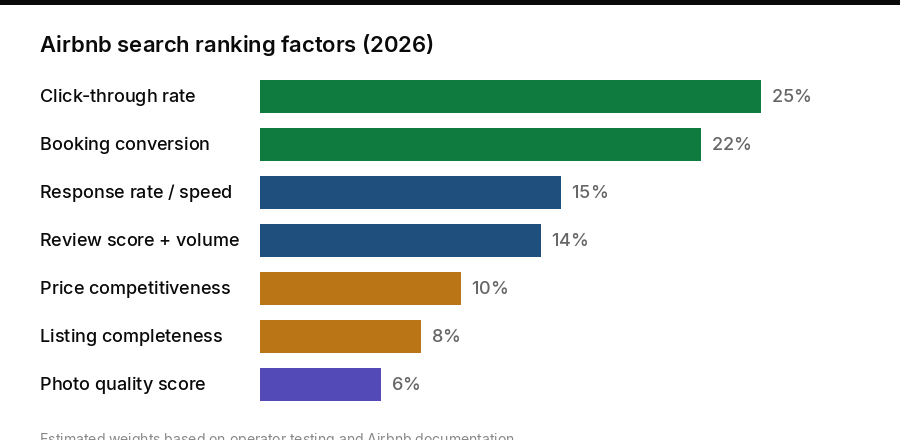
Airbnb prioritizes listings that:
- Generate bookings consistently — The algorithm learns which listings receive inquiries and bookings, and boosts those
- Maintain high review scores — Guest satisfaction is a primary signal of listing quality
- Have strong response rates — Hosts who reply quickly appear higher in search
- Have complete, detailed information — Listings with comprehensive descriptions and amenities rank better
- Maintain active Instant Book settings — The platform rewards instant booking capability
- Have quality, well-organized photos — Visual appeal directly impacts click-through rates and conversions
- Show pricing competitiveness — The algorithm considers price in relation to demand and similar listings
Master Title Optimization for Maximum Visibility
Your listing title is one of the most important ranking factors. It's the first thing guests see, and Airbnb's algorithm heavily weights it for search relevance.
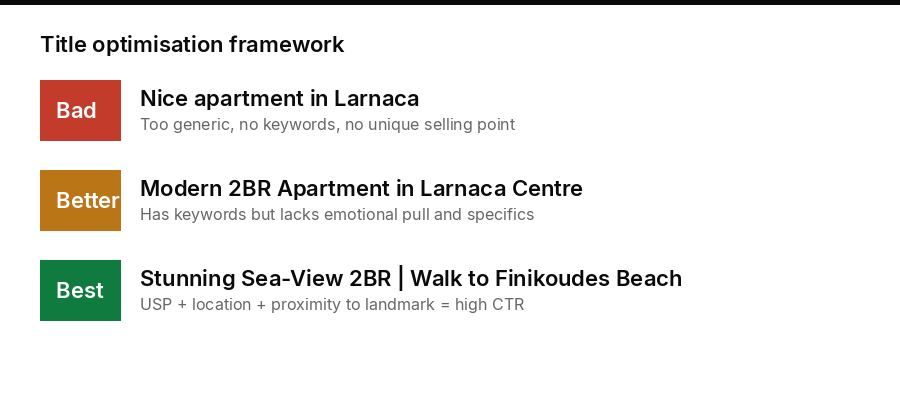
The Formula for High-Converting Titles
Follow this structure for maximum impact:
[Primary Descriptor] + [Location Specificity] + [Key Unique Feature]
Instead of: "Beautiful Apartment"
Try: "Luxury Studio in Manhattan — Rooftop Views, King Bed"
Key principles for titles:
- Lead with the property type — "Cozy Studio" or "Spacious 3-Bedroom House" tells guests immediately what they're getting
- Include location details — Neighborhood name, proximity to landmarks, proximity to transit
- Highlight one key differentiator — Pool, city views, garden, fast WiFi, etc.
- Keep it under 50 characters when possible — Titles get truncated on mobile; prioritize readability
- Avoid clickbait or misleading descriptors — This increases your cancellation rate and lowers ranking
Description Writing Framework for Higher Conversions
Your listing description is where you convert browsers into bookers. While it impacts SEO, its primary purpose is persuasion.
Structure your description with this proven framework:
1. Opening Hook (2-3 sentences): Answer "What makes this listing special?" Lead with your strongest selling point — a stunning view, unique location, specific experience you offer.
2. Property Overview (3-4 sentences): Describe the layout, size, and overall feel. Use sensory language. "Light-filled living room" beats "big living room."
3. Amenities That Matter (5-8 bullet points): Don't list every single amenity. Instead, highlight ones that guests specifically filter for: fast WiFi, air conditioning, heating, washing machine, workspace, parking.
4. Unique Experiences (2-3 sentences): What can guests do in this space? Work remotely? Host dinner parties? Enjoy sunrise yoga on the balcony?
5. The Neighborhood (3-4 sentences): This section should include relevant keywords like restaurant names, transit access, and attractions. "Walk to Central Park," "5 minutes from Times Square," "Near top-rated restaurants in Soho."
6. House Rules & Logistics (2-3 sentences): Be clear about check-in time, parking details, and any house rules. Transparency reduces cancellations.
Photo Sequencing Strategy for Maximum Impact
Photography directly impacts both ranking and conversion rates. Guests decide in seconds whether to click through to your full listing based on the thumbnail photos in search results.
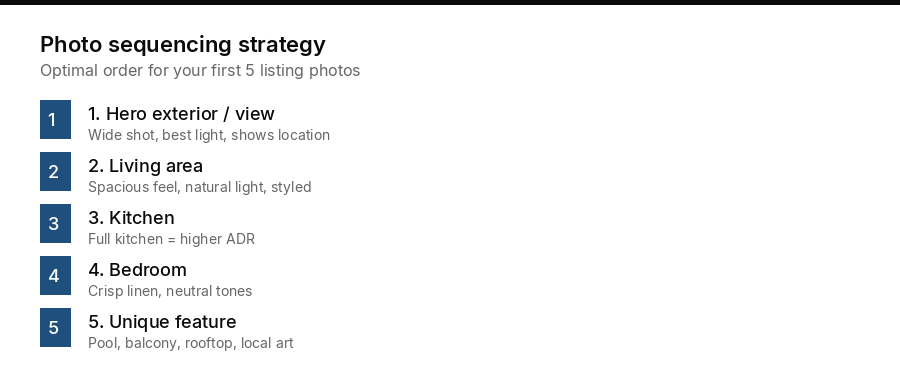
The Winning Photo Order
- Primary Photo — Make it stunning: This is your hero image. It should show the property's best feature in the best light. If you have a view, showcase it. If you have an inviting living space, lead with that. In listings we manage, changing the lead photo alone has produced some of the largest click-through gains of any single edit — though Airbnb does not expose impression data directly, so this is measured through saves and enquiry volume rather than a reported CTR.
- Bedroom Photos: Guests care deeply about where they'll sleep. Show all bedrooms clearly, with good lighting and made beds.
- Bathroom Photos: Clean, well-lit bathroom photos signal quality. Show the toilet, shower/tub, and vanity.
- Kitchen (if applicable): Show counter space and appliances.
- Living Area: Show the full living space with seating.
- Amenities: Pool, patio, workspace, etc.
- Neighborhood Context: A photo of your street, building entrance, or view helps guests navigate.
- Additional Detail Shots: Close-ups of luxury bedding, high-end appliances, or unique features.
Photography Standards:
- Use professional photography if possible (investment of $200-500 typically returns 15-25% higher booking rates)
- Ensure bright, natural lighting — avoid dark or overly yellow-tinted photos
- Shoot during daytime when possible
- Use a wide-angle lens to show space depth
- Stage the space — declutter, make beds, add fresh flowers or coffee
- Ensure all 10+ photos are high resolution (avoid blurry or poorly composed shots)
Amenity Filter Optimization
Airbnb's search algorithm heavily weights amenities because guests actively filter for them. Missing key amenities doesn't just hurt your ranking — it prevents your listing from appearing in filtered search results entirely.
Must-Have Amenities in 2026:
- WiFi (non-negotiable for most guests)
- Air Conditioning or Heating (depending on climate)
- Parking (if applicable to your market)
- Workspace / Desk
- Washing Machine or In-Unit Laundry
- Hot Water / Shower
- Kitchen or Kitchenette
Premium Amenities That Command Higher Rates:
- Pool
- Hot tub
- Gym or fitness center
- Air purifier
- Doorman or security
- Coffee maker
- Wheelchair accessibility
Be honest about amenities. Listing amenities you don't actually have leads to negative reviews, higher cancellation rates, and algorithmic penalties.
Strategic Pricing for Algorithm Optimization
Pricing isn't just about revenue — it's an Airbnb ranking signal. The algorithm tracks how your price compares to nearby listings and how it affects booking conversion rates.
Pricing Strategy Framework:
- Research comparable listings: Use Airbnb's search or tools like Airbnb analytics services to understand market rates
- Start competitively: New listings with good reviews get boosted. Price 5-10% below market initially to generate bookings and reviews
- Increase gradually: Once you have 10+ positive reviews, incrementally raise prices
- Use dynamic pricing: Price higher during peak season, events, and high-demand periods
- Monitor occupancy: If you're getting few bookings, you're likely overpriced relative to the algorithm's assessment of your property
Review Management and Response Rate Excellence
Your review score and response rate are among the strongest ranking factors. Airbnb wants to promote hosts who are reliable and professional.
The Review Score Impact
Airbnb's algorithm heavily favors listings with 4.85+ average ratings. The jump in visibility between 4.7 and 4.85 is significant. Even one negative review can drag down your rating if you don't have many total reviews.
To maintain high reviews:
- Respond to every review (even negative ones) within 24 hours
- Thank guests for positive reviews and address their specific positive comments
- Respond professionally to negative reviews — apologize, offer context, and show you take feedback seriously
- Deliver consistently on your listing promises
- Focus on cleanliness above all else (this is the #1 review driver)
- Communicate clearly with guests before, during, and after their stay
Response Rate and Speed
Airbnb explicitly states that response rate affects visibility. A 100% response rate that achieves responses within 1 hour will boost your listing higher than a 95% response rate with slower replies.
Actionable steps:
- Enable message notifications on your phone
- Set auto-responses for inquiries sent after business hours (if applicable)
- Aim for responses within 2 hours, ideally within 30 minutes
- Use pre-written templates for common questions to speed response time
Instant Book and Booking Velocity
Enabling Instant Book allows guests to reserve without your prior approval. While this might seem risky, Airbnb's algorithm strongly rewards hosts who embrace Instant Book.
Why Instant Book matters:
- Listings with Instant Book enabled rank 20-30% higher than those without it
- Guests overwhelmingly prefer Instant Book — it reduces friction in the booking process
- You can set specific requirements (minimum stay, advance notice, etc.) to protect yourself
- You can disable Instant Book temporarily when you want to vet specific bookings
To minimize risk with Instant Book:
- Require a minimum 2-3 night stay to reduce short-term turnover costs
- Require advance notice (at least 3-5 days)
- Set specific check-in windows
- Trust Airbnb's verification system — their data shows verified guests have comparable cancellation rates to screened guests
Minimum Stay Strategy
Your minimum stay setting affects both ranking and revenue. There's a nuanced optimization here.
The algorithm favors:
- Flexible minimum stays (1-3 nights) for better ranking visibility
- Listings that generate consistent bookings, even if they're shorter stays
But you need to optimize for your property type:
- Urban studio/1BR: Keep minimum stay at 1-2 nights to maximize bookings and ranking
- Suburban house: 2-3 nights minimum is often optimal to cover turnover costs
- Beachfront/vacation property: You can sustain 3-5+ night minimums during peak season and still rank well due to demand
Superhost Status as a Ranking Accelerator
Becoming a Superhost—Airbnb's elite host status—provides ranking advantages beyond the prestige.
Superhost requirements (2026):
- Maintain an average rating of 4.8 or higher
- Maintain a response rate of 90% or higher
- Complete at least 10 stays as a host with a maximum of 1% cancellation rate in the last year
The ranking benefits are significant: Superhost listings appear higher in search results, and guests actively filter for Superhost status. If you're close to Superhost status, the final push is worth the effort.
Leveraging Internal Linking Strategy
If you manage multiple Airbnb properties, you can create a portfolio or website (like a professional site at karakontis.com) that links to your listings. This helps potential guests discover all your properties and improves your overall online presence.
The Complete 2026 Airbnb SEO Checklist
- Title: Includes property type, neighborhood, unique feature
- Description: Follows the 6-part framework (hook, overview, amenities, experiences, neighborhood, logistics)
- Photos: 10+ professional, well-lit images in strategic order
- Amenities: All applicable amenities listed honestly
- Pricing: Competitively priced for your market
- Instant Book: Enabled with protective requirements
- Response Rate: Aiming for 100% within 2 hours
- Review Score: 4.8+ average or active plan to improve
- Minimum Stay: Optimized for your property type
- Calendar: Up to date and accurate availability
Conclusion: Your Airbnb SEO Action Plan
Ranking higher on Airbnb and converting more bookings isn't mysterious — it's a systematic process of optimizing the factors the algorithm rewards. In 2026, the hosts winning the most bookings are those who combine technical optimization (titles, descriptions, amenities) with operational excellence (fast responses, high reviews, Instant Book).
Start with the highest-impact changes first: professional photography, title optimization, and enabling Instant Book. In our experience these three changes together move booking rates more than anything else on this list. Then systematically work through the remaining optimization areas.
If you need expert help optimizing your Airbnb strategy or have multiple properties to manage, consider working with a hospitality consultant who specializes in Airbnb optimization. Many hosts find professional guidance accelerates results significantly.
The Airbnb market rewards hosts who invest in optimization. The gap between a well-optimised listing and an average one, in the same building at the same price point, is routinely twenty points of annual occupancy — which is the difference between a property that works and one that does not.